

PDF download
219136
Press release
Forestry in a time of change: focusing on people
May 7, 2026
- The importance of people for the future of the forest
- Overcoming the shortage of skilled workers, and new job profiles
- Focus on occupational health and safety
The forestry industry is currently undergoing a profound transformation in a number of ways. Climate change requires a new direction in forest management. Digital forest management as well as high-tech machinery and equipment, open up new possibilities for that. Nevertheless, people remain at the heart of forestry - they develop, manage, and implement measures. From October 15 to 18, 2026, INTERFORST—the leading international trade fair for forestry and forestry technology—will showcase the entire forestry value chain under the key topic “People in Focus”.
According to the “Charter for Wood 2.0” initiative launched by the German Federal Ministry of Agriculture, Food and Regional Identity (BMLEH), around one million people in Germany work in the forestry and timber cluster, which includes forestry companies, forest owners, sawmills, and the paper and furniture industry. With approximately 120,000 companies and annual revenue of over EUR 187 billion, the forestry and timber cluster is a major economic factor. In the European Union, around 3.6 million people are employed along the entire value chain of the forestry and wood-based industries (Employment in Forestry and Wood-Based Industries, 2024).
Sustainable forestry is not possible without dedicated people. Through their knowledge and work, forest workers, foresters, entrepreneurs, scientists, and forest owners ensure the ecological, economic, and other socially important functions of the forest. “People in Focus” puts the focus on people as primary shapers, users, and custodians of the forest, making it clear that forests and people work hand in hand.
The future of forestry: skilled workers, young talent, and new job profiles
Many forestry companies report difficulties in finding qualified skilled workers. In particular, forestry machine operators, forest managers, forestry engineers, GIS and data experts are scarce. The acute shortage of skilled workers in the forestry and timber cluster is confirmed in the BMLEH’s “Charter for Wood 2.0”. The reasons are varied: an aging workforce, a shortage of young professionals entering the field, increasing demand for highly specialized skills and technology, and skilled workers moving to other industries. At the same time, the generational transition within companies and forestry administrations, and among forest owners is changing the structure of the industry. New forest owners, who often live in urban areas, are in greater need of advice.
There are various strategies for recruiting skilled workers, including training initiatives and strengthening the industry’s image. In addition, recruiting new workers—particularly women and career changers—as well as more attractive and more family-friendly working conditions play an important role. Although technological and digital solutions can help alleviate the shortage of skilled workers, it is still also important to strengthen collaboration between universities and industry and expand continuing education and professional development opportunities.
The forestry industry has undergone significant technical and structural evolution in recent years. Alongside traditional professions such as forest manager or forester, new specializations are emerging, such as forestry drone pilot, forestry technician with a digital focus, ecology and sustainability manager, or geodata analyst. This requires new qualifications, particularly in the areas of machine operation, data analysis, and digital forest management.
To attract new talent, the industry’s aim is to specifically target young talents. Their technical savvy and diverse interests in social responsibility, climate protection, sustainability, and biodiversity can be put into practice in forestry and enrich it. Vocational training programs and degree programs are therefore being modernized, and digitalization in forestry work brought to life.
“Appreciation, transparent communication, as well as reliable conditions and development opportunities are what make an employer attractive. Clear prospects and good support matter especially when starting a career—and if the work-life balance plays a greater role, it is not a sign of a lack of commitment, but rather a reflection of changing life realities,” explains Caren Raddatz, national spokesperson for the Young Forestry Network (JNF), adding: “Furthermore, many forestry workers today increasingly have to justify their work. Young professionals, in particular, need support in addition to meaningful work and modern work structures. Those who take these expectations seriously will attract committed employees in the long term and strengthen the future of the industry.”
Safety and health in the forest remains a key responsibility
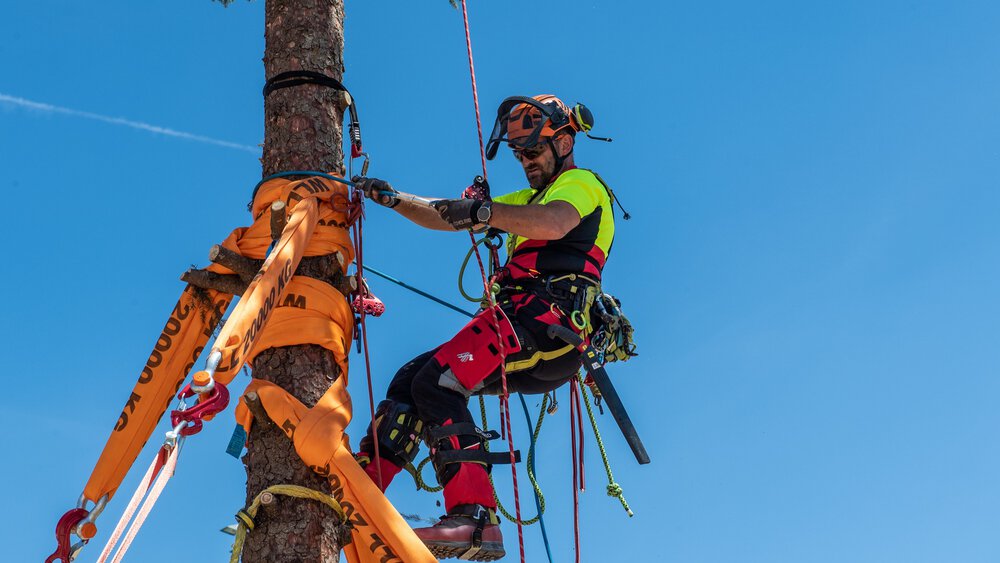
Despite modern forestry technology, working in the forest remains physically demanding and, with 5,188 reportable accidents in 2024 according to the Social Insurance for Agriculture, Forestry and Horticulture (SVLFG), is one of the most dangerous occupations. Accidents repeatedly occur due to falling tree parts, falls on uneven terrain, or while using a chainsaw. Modern forestry machinery, personal protective equipment, training, and clear safety standards act as countermeasures. They help minimize risks and continuously improve working conditions.
As a key player, the SVLFG will be represented at INTERFORST with the focus on occupational safety, health protection, and accident prevention measures.
“Modern technology supports and protects people during forestry work, but it does not replace responsibility and the duty of care toward employees. Occupational safety and health protection must therefore remain an integral part of a sustainable forestry industry. The Social Insurance for Agriculture, Forestry, and Horticulture focuses on effective preventive measures as well as practical information and training. In this way, we make a fundamental contribution to safe and sustainable jobs in the forest,” said Henner Braach, Chairman of the SVLFG.
At INTERFORST, well-known exhibitors will showcase modern protective equipment for forestry work, including companies such as Pfanner Schutzbekleidung GmbH, Lamm GmbH, and HF Sicherheitskleidung Produktions- u. Vertriebs GmbH.
Forestry as a driving force for rural regions
For many people, the forest is an important source of income. Skilled workers in forestry actively contribute to the sustainable development of forests and their preservation for future generations. According to the BMLEH in 2024 in its fourth report on the development of rural areas, 91 percent of Germany’s territory is rural, and more than half of the people in Germany live in rural regions. Forestry jobs are closely connected to the region, often located in rural areas, and make an important contribution to the stability of the local economy. Expanding regional value chains results in new career prospects. Forestry associations, forest cooperatives, and family-owned operations play a vital role in shaping the structure of small privately owned forestland in rural areas.
As the world evolves through climate change, digitalization, and modern technology, people remain the key factor in ensuring sustainable and future-oriented forestry, as well as sustainable management in general. In the context of modern forestry, “People in Focus” therefore means always considering technology, sustainable forest management, and economic value creation in connection with the people who are responsible for these systems and further develop them.
Exciting conference and forum program
The diverse conference program at INTERFORST 2026 will take an in-depth look at “People in Focus”, also in the presentation “Sustainable human resources management in forestry” by Dr. Maria Eberlein, Volksbank Raiffeisenbank. Caren Raddatz, national spokesperson for the Young Forestry Network, will talk about “What makes an employer attractive?”
The presentation on “Safe timber harvesting in the forest of the future” by Christian Grundwaldt, DGUV (German Social Accident Insurance) will address the topics of occupational safety and health protection. The forum will focus on “Generational change in forestry—young and old report about stumbling blocks”, and new forest owners can learn more about the topic “Help! I have (inherited or purchased) a forest—what’s next?”
Tickets for INTERFORST are now available.
Downloads
Belonging images

Felix Kirschenbauer
+49 89 949-21472
+49 89 949-21472Write an e-mail
Write an e-mail