
Forest regeneration and forest management – because reforestation means securing the future.

Climate change presents the forestry sector with a critical challenge: preparing forests for the future. Healthy forests of the future will safeguard habitats for people, animals, and plants, store large amounts of CO₂, and provide wood as a renewable resource. The key to achieving this lies in sustainable forestry and the targeted transition to climate-resilient mixed forests—forests that are vibrant, resilient, and rich in biodiversity.
Afforestation and reforestation can address multiple ecological challenges at once. This is because every tree planted helps reduce CO2, and reforestation helps restore degraded habitats, protect existing biodiversity, and mitigate potential damage from flash floods. There are many good reasons to give the topics of forest renewal and forest management a prominent place at INTERFORST.
Whether it involves site preparation, propagation material, soil improvement, or the management of established stands and young stands: forest regeneration and forest management can be very labor-intensive in some cases, yet they are of great economic and cultural significance. How can an area be optimally planted to meet a specific objective? Which propagation material and seeds are best suited? How can afforestation and planting succeed despite droughts and other climatic challenges? What constitutes ideal young stand care? How can foresters use digital tools to support their work? You’ll find answers as well as proven and innovative solutions at the leading trade fair, INTERFORST. Our afforestation trade fair covers the following topics:
Healthy Forests for the Future
By the way: Our main theme, "Healthy Forests for the Future," also takes a close look at how we can prepare our forests for the future.
Learn moreSurface preparation
A perfectly prepared site is the foundation for a healthy and vigorous forest. When developing new reforestation areas, site clearing must be carried out with the utmost care. Methods used include the Bräcke-Mounder process, as well as various equipment such as excavators and flail mowers. Digital site management makes the work more efficient, predictable, sustainable, and transparent.

Forest reproductive material, seeds, and planting
When it comes to forest renewal and regeneration, the type and quality of the planting stock are crucial. A tree’s growth characteristics must be perfectly suited to the prevailing environmental conditions, such as climate and soil. Equally important: purchasing correctly labeled planting stock from a trusted supplier. This is the only way to ensure that the planted trees are free of genetic defects. Additionally, when applying for subsidies for reforestation areas, the prescribed origins of the trees must be adhered to.
Soil improvement and fertilization
Soil improvement and fertilization play an important role in forestry—particularly in restoring degraded forest soils, improving productivity on nutrient-poor sites, and mitigating environmental impacts such as acid rain. Unlike in intensive agriculture, these are typically long-term, targeted measures in forests that enhance soil fertility and promote ecosystem stability.
Cultural pruning, maintenance pruning, and thinning
To preserve forest areas for future generations, regular forest management is essential—especially in light of the impacts of climate change. This includes, for example, ensuring the right mix of tree species and consistently protecting young trees from wildlife and other animals. To make room for young trees to grow steadily, it may be necessary to reduce the number of trees.
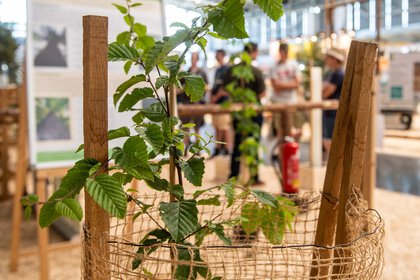
Where necessary, dominant tree stands are thinned out in favor of weaker species, meaning that mixed forests are encouraged. Branch-free quality is crucial for future timber harvesting and good market prices. That is why pruning should begin at an early age. Modern forestry technology facilitates stand management and young stand care, increases efficiency, and protects young trees through precise work. INTERFORST provides information on battery-powered, ergonomic hand tools as well as semi-mechanized methods