

Ensuring that wood reaches its destination safely and efficiently: Timber transport vehicles at INTERFORST

Whether it’s short-log or long-log trucks, modern loading cranes, grapples, or accessories—the timber transport industry is constantly evolving. Higher payloads, more powerful crane systems, digital assistance solutions, and innovative vehicle bodies are now ensuring greater efficiency, safety, and cost-effectiveness throughout the entire transport chain.
At INTERFORST 2026, numerous manufacturers will showcase their modern vehicles, superstructures, and transport solutions. Take this opportunity to learn about the latest developments, experience the technology up close, and engage in conversation with manufacturers and industry experts.
Timber Transport Using Short-Length and Long-Length Trucks
In Germany, short-length timber trucks are predominantly used for transporting wood, as many sawmills process logs into specific lengths. Accordingly, these logs are cut to the required dimensions while still in the forest. Short-length timber trucks transport sections of trees—known as fixed lengths—ranging from two to six meters. There are different configurations of these high-horsepower transport vehicles: The short-log articulated truck is a truck with a trailer, in which both the truck and the trailer are equipped with stanchions—that is, vertical support posts on the timber transporter. The short-log semi-trailer consists of a semi-trailer with multiple stanchion sections. The majority of short-log trucks also feature a loading crane for flexible loading and unloading of logs from the log pile on the forest road. Short-log trucks are suitable for transporting sawlogs, industrial wood, and pulpwood; they offer greater maneuverability than long-log vehicles and typically have a higher payload capacity than comparable combination vehicles designed for both short and long logs.
Long-log trucks transport whole tree trunks with a length of about 7 to 20 meters. Logs of this length are primarily used in the high-quality roundwood industry, for example, in veneer production or the manufacture of poles, such as power poles and flagpoles. Typical configurations include the long-log truck, which consists of a tractor unit with a log-loading crane and a separate dolly that carries the rear end of the logs. There is also the long-log semi-truck, which consists of a tractor unit with a special timber trailer. This is particularly well-suited for long-distance transport. Here, too, stanchions secure the logs during transport. In addition, long-log trucks are typically equipped with a loading crane.
While long-log trucks are evolving technically into specialized vehicles for transporting long, high-quality logs, short-log trucks are increasingly becoming highly efficient work machines with powerful cranes, high payloads, and modern digital technology.
Modern Body and Loading Technology for Timber Transport Trucks
Truck bodies ensure the safe transport of roundwood. Depending on the log length, there are bodies designed for short logs, long logs, or a combination of both. These bodies typically feature stanchions (vertical posts) mounted on the sides of the vehicle to secure the cargo during transport. The stanchions can be moved, removed, or folded down to accommodate different log lengths. In addition, telescoping frames are available to adjust to varying log lengths.
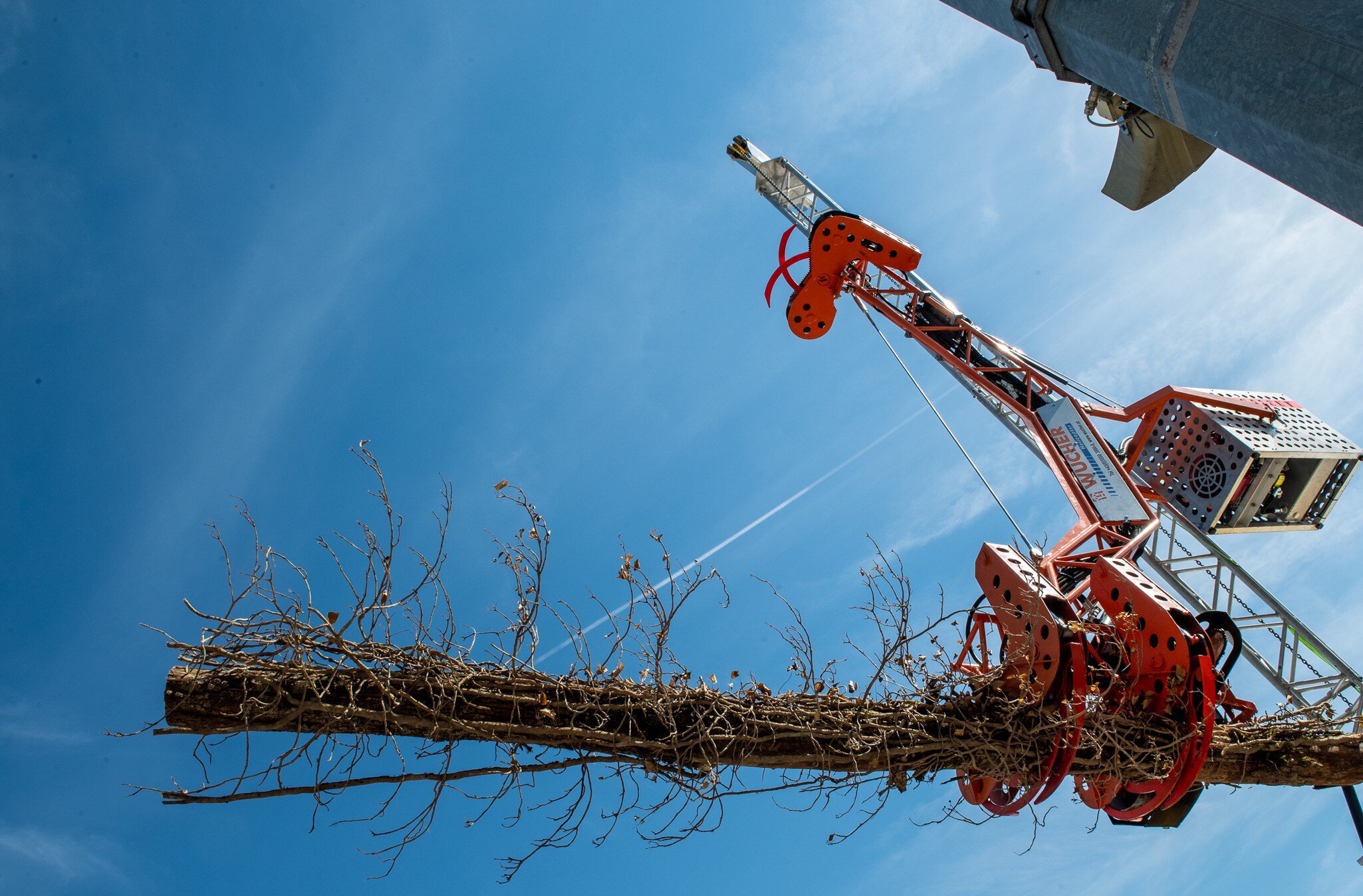
Truck loading cranes are used to load and unload the logs. The most common type is the central crane, which is mounted directly behind the cab. Alternatively, a rear-mounted crane is used. The hydraulic articulated boom crane is standard for timber transport, and radio-controlled loading cranes are also widely used. High-performance cranes have a particularly long reach and lifting capacity. Grapples at the end of the loading crane enable the picking up and setting down of logs. They typically feature a hydraulic rotator (360° rotation) for precise positioning of the logs. They come in various sizes and designs—depending on the product range and application, a distinction is made between roundwood grapples, multipurpose grapples for various types of timber, industrial timber grapples for thinner logs, and heavy-duty grapples. Each crane and every technical component fulfills its own highly specialized niche and complements the professional range of mounting and loading technology showcased at INTERFORST. In addition to adjustable stanchions, rotators, log grapples, and radio-controlled crane operation, the equipment on a modern log hauler typically includes a weighing system that prevents the vehicle from being overloaded. Lashing chains and tension belts help to further secure the load. LED work lights illuminate the work area in the forest during darkness or when visibility is poor due to weather conditions. In addition, timber haulers are equipped with camera systems, a tire pressure regulation system, underrun protection—often necessary in the forest—and a winch. Telematics systems monitor vehicle data, location, and travel times, and optimize transport processes.
Together, these technologies ensure safe, efficient, and cost-effective timber transport from the forest to the processor.
Material Handling Equipment and Loading Aids in Timber Transport
In the context of timber transport, these machines are primarily used at depots, timber storage yards, transshipment terminals, as well as in sawmills and wood-processing facilities. Forklifts complement the capabilities for loading, unloading, and internal transport of timber, pallets, and accessories at storage yards and within facilities. Telescopic forklifts lift, load, and move timber even over greater heights and distances. Work platforms and aerial access equipment ensure safe access to elevated areas of vehicles for maintenance, repair, and inspection work. Loading ramps allow vehicles or machinery to be driven onto transport vehicles. This enables, for example, the harvester to be transported over longer distances to a new location via a flatbed trailer.