
Perfectly positioned: Woodworking takes center stage at the trade show

What methods are available for processing wood quickly and effectively? What can mobile sawmills do? And how can metal objects be reliably located? INTERFORST provides you with a comprehensive overview of the most important woodworking techniques—from quality assurance and mobile sawmills to recycling and disposal.
What sets the INTERFORST trade fair apart from others is its coverage of the entire value chain—which extends far beyond forestry work. A prime example is the woodworking sector, on which several renowned suppliers are focusing.
Mobile sawmills and accessories
There is a wide selection and variety of mobile sawmills available, as they represent a better alternative for many forest owners compared to large stationary sawmills. The advantages are clear: on-site processing is particularly attractive for local producers and buyers, as it eliminates the need for costly transportation and storage. The wood does not need to be pre-sorted, as the mobile sawmill can be adapted to any log, which guarantees higher quality, especially for high-value timber. Additionally, sawdust and offcuts are minimized through the direct processing of scraps into firewood or wood chips.
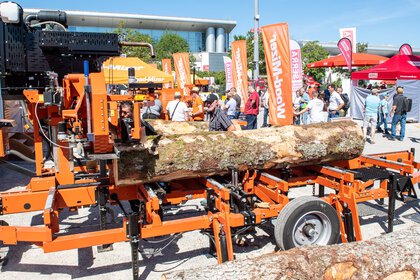
Why is it important to stay up to date on this topic? Because the latest sawmill technologies ensure an even more efficient supply of sawn timber, and smart recycling techniques enable the cost-effective disposal of wood waste.
In short: one investment—many economic benefits.
Sawmill technology
Round timber cannot be processed into sawn lumber without sawmill technology. It is only through the sawing process that the desired beams, square timbers, planks, battens, and boards—in other words, sawn lumber—can be cut from irregularly shaped round timber.
It sounds simple, but it comes with its challenges, as the raw material itself is subject to many different variables. The logs vary in diameter and length, as well as in growth and moisture content. The greater the variations, the more closely the machining process must be monitored. This is especially true given the clear minimum requirements for the finished product: cross-sectional dimensions must fall within specific tolerances, lengths must be uniform in some cases, and moisture content and quality grades are often specified as well.
Many factors have led to a wide range of developments in sawmill technology. For example, this has resulted in the creation of semi-automatic or fully automatic frame sawmills, log band sawmills, and circular sawmills, designed to process every type of lumber as efficiently as possible and compensate for deviations from the target dimensions. The workflow, however, remains the same: sorting the logs, cutting, and sorting the sawn lumber.
Digitalization in sawmill technology is fundamentally transforming the woodworking industry. The intelligent networking of machines, sensors, and IT systems is giving rise to highly automated, data-driven production processes. These help increase efficiency and enable the more targeted and resource-efficient use of wood as a raw material. The use of 3D scanners and artificial intelligence enables round timber to be measured precisely, quality to be reliably assessed, and cutting processes to be optimized in real time. The machines along the sawing lines are interconnected, continuously exchange data, and automatically adapt their operations to material properties and order requirements. At the same time, digital systems manage the material flow, ensure greater transparency in processes, and guarantee seamless traceability of the wood.
As a trade fair for woodworking, INTERFORST offers products and solutions for all stages of wood processing in sawmills—from the delivery, storage, and sorting of roundwood, through processing into sawn timber, to the sorting, storage, and drying of sawn timber.
Recycling Technology and Waste Disposal
Cutting roundwood and thinning forests generates large quantities of wood and pruning waste, which must be disposed of or processed further—for example, into firewood, wood chips, pellets, or paper. Learn about innovative recycling techniques and the latest disposal options at INTERFORST.
Devices for locating metal objects
As a result of World War II, entire stands of trees are still damaged by bullets and shrapnel. Smaller particles, in particular, cannot be detected with the naked eye, so the extent of the contamination can only be determined during further processing.
The problem: Even the smallest metal particles can significantly disrupt the sawing process. They cause damage to saw teeth and blades and compromise process stability. In addition, overheating can occur, and the resulting sparks pose a significant safety risk in a production environment with highly flammable materials such as wood. To avoid this risk, detection devices that identify foreign objects should ideally be used even before felling, thereby preventing potential machine damage during wood processing.