
Focus on Protective Forests: From Forest Plants to Municipal Engineering

The management of forests and landscapes, as well as parks and green spaces, is essential: people and animals need nature and its resources—as a habitat, as a source of food, and as a means of protecting the climate. This makes conservation, creation, maintenance, and expansion all the more important, with sustainable forest management playing a crucial role. That is why the topic of protective forests and recreational forests is one of the major themes at INTERFORST—ranging from forest plants to tree care and arboriculture to municipal technology.
Is our commitment to protective and recreational forests truly sufficient? What machines, equipment, materials, and systems enable optimal forest management? What are the concrete impacts of climate change? How can municipal infrastructure be optimally configured? Our Protective Forest section provides answers to these and other questions. The range of topics? As broad as it is deep. And because nothing is as urgent as the responsible stewardship of nature, forest protection in the context of climate change holds a special place at the forestry trade fair—for example, at the congress, in the forum, at the special exhibition, and on the Green Couch.
Planting and Maintenance of Protective Forests and Protective Woodlands
Protective forests—also known as protective woodlands—play a vital role in safeguarding settlements, infrastructure, and landscapes against natural hazards. Especially in mountainous regions, mountain and avalanche protection forests can help reduce risks such as rockfalls, avalanches, erosion, and mudslides. Even in lower-lying areas, forests make an important contribution to flood and soil protection by storing water, slowing runoff, and stabilizing the soil. The establishment and maintenance of such protective forests include, among other things, reforestation measures, maintenance work, slope stabilization, and the use of specialized forestry equipment for steep or hard-to-reach terrain.
Protective Forests and Climate Change
The effects of climate change are visible everywhere—for example, in the form of more hot days and fewer days with frost, longer growing seasons, new pathogens, and an increase in extreme weather events and drought. These factors also affect forest structure and tree species composition. That is why it is advisable to classify forests based on site conditions, soil characteristics, water availability, and climate scenarios. Why? Because this allows for the creation of a customized planning framework for reforestation and forest management, enabling forests to be made more climate-resilient.
Modern forestry is increasingly relying on digital land management systems supported by satellite, drone, scanning, and sensor technologies. The data collected through these systems is analyzed using artificial intelligence to enable informed decision-making and to optimize management measures in a targeted manner. At the trade show, visitors will gain insights into suitable machinery, equipment, and methods, as well as digital tools. In addition, information will be provided on funding programs for protective forest measures, such as climate-adapted forest management or the Forest Climate Fund.
Tree Care
Essential not only in forests but also in urban areas: tree care for the restoration of protective forests. The goal is to preserve trees, prevent unhealthy growth, and improve and restore their vitality. Another important aspect is ensuring traffic safety where trees grow along roads and railways. Here, too, INTERFORST offers the best possible overview of current methods, tools, and trends.
Landscape Management and Agricultural Engineering
Landscape conservation is primarily about protecting nature and creating and preserving healthy natural areas as habitats and recreational spaces for people and animals. How can we preserve these areas for future generations? How much maintenance is actually necessary? When should we intervene in natural growth, and when is it better not to? Our supporting program offers further information—with practical lectures and events.
Municipal Engineering
Whether it’s facility management, street and city cleaning, winter maintenance, or the design and upkeep of green spaces: without municipal technology, local governments simply couldn’t function. This also includes fleet management for highly specialized municipal vehicles, which are essential for carrying out the wide range of tasks required by a city or municipality. Our recommendation: Check our exhibitor directory in advance to see which companies and products are relevant to you.
Recreational facilities in the forest
In addition to its practical and protective functions, the forest serves as a recreational space. With its clean air, it is often described as the “green lung” near urban areas. Whether hiking, biking, or jogging—it offers space for activities and rejuvenation. A well-developed infrastructure is essential for the diverse recreational use of the forest. This includes seating such as benches and tables, adequate signage, as well as educational and fitness trails.
What other possibilities are there, and how can recreational facilities be best implemented in the forest? INTERFORST offers a wealth of ideas and inspiration in this area as well.
Nurseries, wild shrubs, and Christmas tree plantations
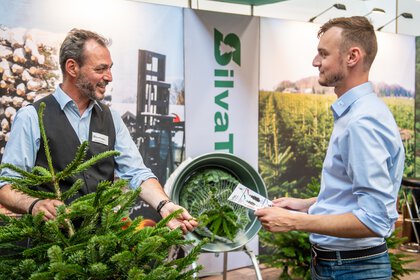
From the general benefits of trees to the specific: Learn which species are particularly resistant to bark beetles or can withstand climate change. But it’s not just about what—it’s also about how—when it comes to reforestation and the restoration of protective forests: That’s why you’ll find a wide range of equipment and techniques here for planting native trees and shrubs and Christmas tree plantations, as well as comprehensive ideas for the product range and equipment of tree nurseries.
Machines, Equipment, and Systems
If you want to achieve optimal results, you don’t just use any tool—you use the right one. You’ll find exactly what you’re looking for at INTERFORST. The product range includes machinery, equipment, systems, and accessories for the establishment and maintenance of protective forests and protective woodlands, for tree care, for municipal engineering, as well as for landscape management, agricultural engineering, and the promotion of protective forests.