

Log Yard Technology: Moving Logs Efficiently and Processing Them with Precision

Efficient timber handling and precise roundwood processing are core elements of a modern, economically viable forestry and timber industry. Today, high-performance excavator and crane systems, innovative debarking technology, and intelligent measurement and control systems work together seamlessly to optimize the flow of materials at logistics hubs and in sawmills. Experience these technologies firsthand at INTERFORST 2026 and see the machines in action. Talk directly with manufacturers and experts on-site about modern log yard technology.
Timber Handling: Machinery, Technology, and Modern Developments
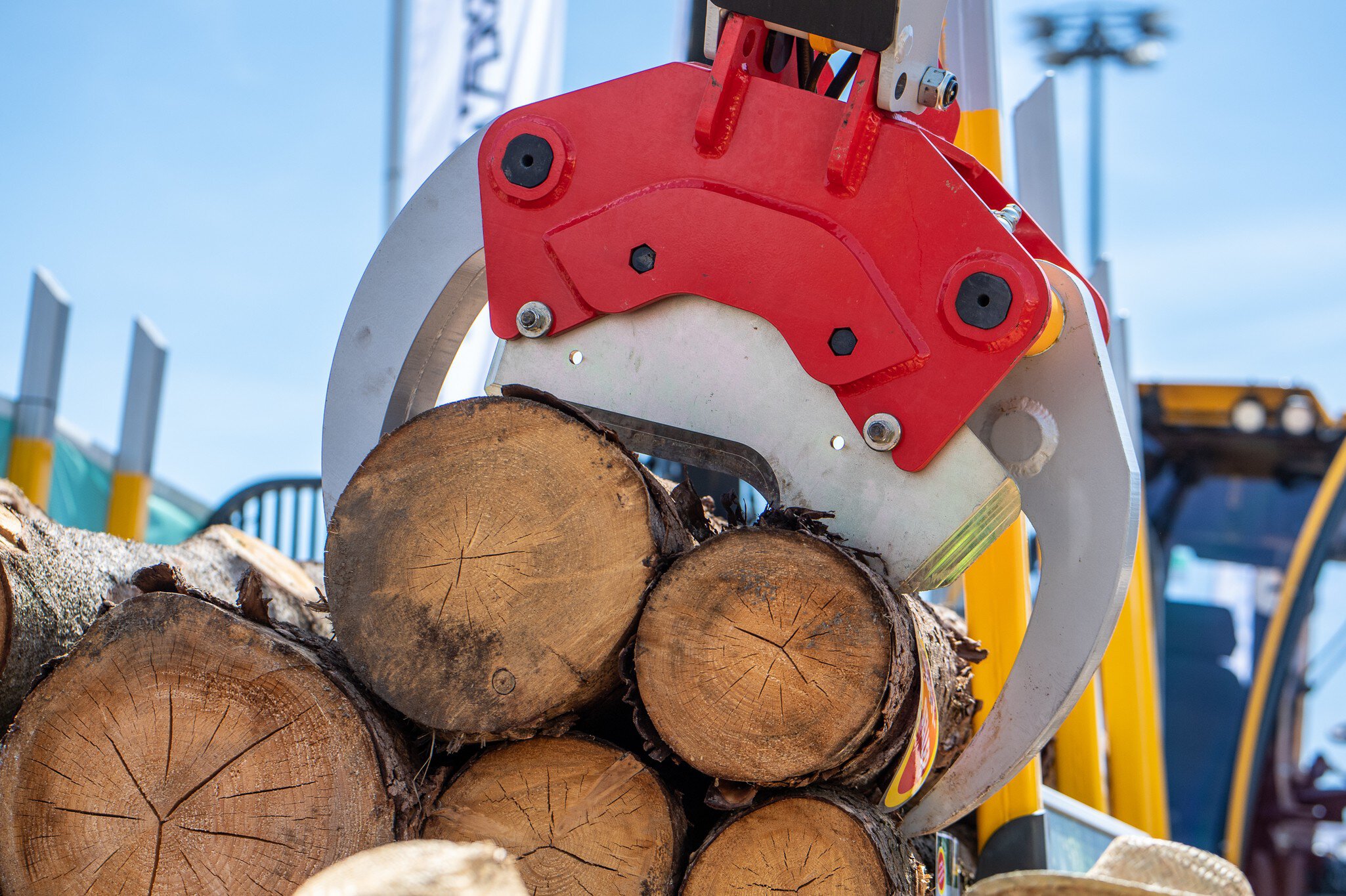
Timber handling involves the loading, unloading, and sorting of logs or sawn timber at logistics hubs and in sawmills. For transport, timber is loaded onto trucks, railcars, or ships and unloaded again at its destination. Highly specialized vehicles and equipment make this possible and preserve the quality of the heavy cargo. Among the most important are material-handling excavators, wheel loaders, and timber grapples. The material-handling excavator allows for the simultaneous gripping and transport of logs. Robust wheel loaders can load large quantities of timber onto trucks or railcars in a short amount of time. When it comes to the precise stacking and loading of timber, agile telescopic loaders with extendable arms are used. Timber-handling machines are specifically designed for handling roundwood at large timber yards. Special attachments and tools are available for these machines. To ensure that all work steps—such as gripping and moving timber—are performed safely, excavators and loaders are equipped with special grapples, known as timber grapples. Rotators enable free rotational movements and secure gripping, thereby facilitating the precise alignment and placement of the timber. Timber handling is increasingly shaped by the electrification of machines, automated processes, and digital systems for inventory tracking. INTERFORST showcases the latest developments and industry trends.
Wood Debarking Methods and Machines
Depending on the application and capacity, there are various types of machines for debarking logs. Ring debarkers and rotor debarkers are typically used in sawmills. In a ring debarker, the log is fed through a ring equipped with rotating blades. This enables high throughput, particularly with straight round logs. Rotor debarkers can process logs of varying thicknesses, as well as eccentric and slightly crooked logs. Here, a rotor equipped with movable debarking tools removes the bark while the log is being transported. Alternatively, milling and chain debarkers remove the bark from the logs using rotating milling tools or chains. In the pulp and paper industry, drum debarkers are used, in which several logs are moved together inside a rotating drum, and the bark is removed by friction. For use directly in the forest or at timber yards, mobile debarking machines or debarking attachments mounted on excavators and harvesters are used. In this technical area of the forestry and timber industry as well, the development of debarking machines is primarily focused on greater efficiency, sustainability, and digitalization.
Digitalization and Control Technology in Log Yard Operations
In the field of roundwood yard technology, a wide variety of technologies are used today to process wood more quickly, more accurately, and more cost-effectively. For example, laser scanners can be used to generate a 3D model of the log. 2D and 3D camera systems reliably identify wood species, bark condition, end faces, and quality characteristics. Radio frequency and barcode systems allow individual logs or stacks to be tracked throughout the entire production process. GPS systems are used to locate stacks in the forest and machinery at large timber storage yards. Control technology automates the entire production facility. Programmable logic controllers (PLCs) control the conveyor systems, debarking lines, sorting lines, and cranes. They work in conjunction with sensors, hydraulic controls, and visualization systems to enable the automated operation of the entire roundwood line. In doing so, they detect and record product data and malfunctions. The optimization software uses data from the 3D scanner to determine the ideal processing method for each log. By combining these technologies, modern roundwood yards can increase wood yield, optimize material flows, reduce downtime, and ensure seamless traceability of the raw material.