
Technically well-equipped for timber harvesting and skidding

The better the equipment, the faster, safer, and more efficient forest management, timber harvesting, and log hauling become. What’s needed here are high-performance forestry machines of all sizes. Whether you’re looking to expand or upgrade your existing fleet, INTERFORST provides an overview of the latest innovations in forestry machinery and supplies.
By the way: State-of-the-art forestry technology is also the focus of our special feature, “Forestry Technology: Breaking New Ground.”
Timber harvesting
Modern timber harvesting is a highly mechanized, efficient, and precise process carried out primarily by heavy forestry machinery to ensure workplace safety and efficiently harvest wood as a raw material. It combines technological advancements with environmental requirements such as soil conservation. The harvester is the heart of modern timber harvesting. It fells, delims, and cuts the tree into sections in just a few minutes. The harvester operator sits in a safe cab, which drastically reduces the risk of accidents compared to manual felling. Manual timber harvesting is still necessary for trees that the harvester cannot reach, particularly large trees, or for work in young stands.
Logging
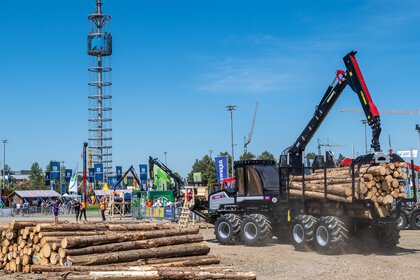
While this work was often done by logging horses in the past, specialized forestry machinery is now predominantly used. This includes, above all, forestry tractors, forwarders, cable winches, and mobile or stationary cable crane systems, which can be used to transport logs over longer distances or from hard-to-reach areas. In particularly steep or rugged terrain, timber is sometimes also transported by helicopter—a process known as heli-logging. Modern logging technology thus enables efficient and, as far as possible, soil-conserving transport of timber within the forest.
Specialized Hydraulics and Pneumatics
In modern forestry machines, specialized hydraulic and pneumatic systems play a central role, as they enable the safe and precise handling of heavy timber loads. Hydraulic systems control, for example, cranes, grapples, cable winches, and the working units of harvesters and forwarders, ensuring that trees can be felled, delimbing, cut to length, and transported. High-performance pumps, valves, and cylinders transmit high forces while also enabling precise movements even in difficult terrain. In addition, hydropneumatic components are used in suspension and damping systems to improve the stability, ease of operation, and efficiency of modern forestry machines.
Digitalization
Modern forestry technology is driving the digitalizationand sustainability of forest management. From precise planning through logging and forest maintenance to timber storage, digital systems and connected “smart machines” enable more efficient, safer, and resource-efficient processes.
Since there are physical limits to how much the performance of conventional machines can be improved, digitalization is unlocking additional potential. Modern sensor technology, comprehensive data management, and improved human-machine communication are reshaping the world of forestry technology. AI-powered applications open up possibilities for digital inventory management, enable real-time monitoring and predictive modeling—and thus provide new foundations for decision-making.
Autonomous and semi-autonomous machines, high-precision technologies, sensor systems for workplace and forest safety, as well as real-time data and intelligent assistance systems are opening up new dimensions in efficiency, transparency, and sustainability. In this way, forestry technology is becoming the key to climate-resilient, economically strong, and ecologically responsible forests.
By the way: The topic of digitalization is also a central focus of our main theme, “Digitalization in Forestry & Wood.”
SYSTEMS & COMPONENTS Forestry by DLG
Also exciting: The new SYSTEMS & COMPONENTS Forestry by DLG section, launching in 2026, focuses entirely on technical components for the forestry sector and offers an overview of technical solutions, innovations, and industry-specific developments. Be sure to check it out!
Learn moreBogie tracks for environmentally friendly forest management
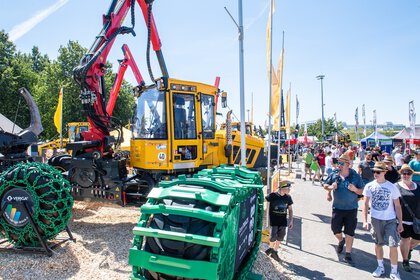
Protecting the forest is a top priority in forestry. However, working with heavy machinery places a heavy burden on the forest floor and can cause serious damage. This is due in part to the machinery’s extreme weight and in part to frequent travel over the same areas. This problem can be solved with bogie tracks, which can be attached, for example, to the wheels of forwarders. They minimize soil disturbance caused by heavy machinery and protect the forest’s root systems.
Mobile fueling stations
Forestry machinery also needs to be refueled regularly. Since work sites are often located far from public gas stations, mobile fueling stations allow for flexible refueling directly in the forest or on the skid trail. The portable tanks—usually made of steel or polyethylene—can be transported on pickup trucks, trailers, or trucks and are often equipped with pumps, hoses, and fuel nozzles, allowing machines to be refueled quickly and safely on site. Depending on the application, the systems vary in size, material, and equipment and are available in various capacities, ranging from compact tanks to larger systems holding several hundred to over a thousand liters. This helps reduce downtime and allows for more efficient organization of fuel logistics in forestry operations.